Rooted Tree Services provides high-volume arboricultural assessments, large-scale clearing, and technical risk mitigation for tier-one utility contractors, municipal bodies, and major institutional networks across the Greater Toronto Area.
Our operations are purpose-built to navigate intense administrative workflows, pass strict safety screenings, and execute massive project blueprints flawlessly alongside active civil infrastructure.
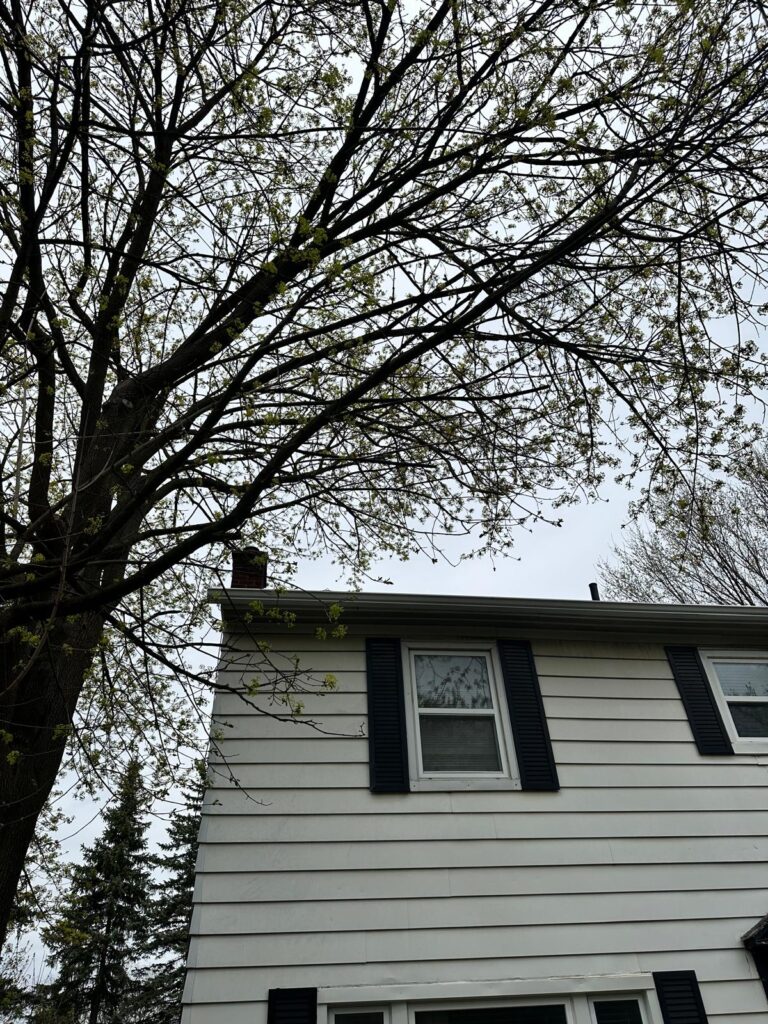
Large tree leaning toward a house in Riverside, Toronto requiring a professional tree risk assessment.
Is It Dangerous
A tree leaning toward your house isn’t automatically dangerous. What matters is why it’s leaning — and whether the root system is still stable. Some trees grow at an angle for decades without risk. Others lean because something underground has already failed. From the ground, homeowners usually can’t tell the difference.
What actually causes a tree to lean
In Toronto’s older neighbourhoods, we see four main causes.
Root instability – Soil movement, rot, construction damage, or saturated ground can weaken anchoring. The tree may look unchanged for years — then shift suddenly after a storm.
Root compaction – Heavy equipment, patios, driveways, or structures placed over root zones restrict oxygen and water movement. Over time, the root system weakens and anchoring strength drops. Think of this like a kink in your water hose stopping water flow.
Structural weakness in the trunk – Internal decay often isn’t visible from outside. Trees compensate until they can’t.
Natural growth toward light – Some trees lean as they grow toward open space. These can be stable — but only if the root system is strong.
The challenge is knowing which category yours falls into:
Signs the lean might be a real risk
You don’t need to panic every time you notice a tree angle. But certain changes matter:
The lean is new or increasing
Soil is lifting around the base
Cracks appear in the ground or trunk
The canopy feels heavy on one side
Branches now extend over your roof or hydro lines
The lean worsened after a storm
These are structural signals, not cosmetic ones.
What usually surprises homeowners:
Most dangerous trees don’t look dramatic. They fail because of what’s happening underground — root decay, soil movement, slow structural compromise, or buried watercourses and historic drainage paths that run beneath many GTA properties.
Waiting until a tree “looks bad” is often too late.
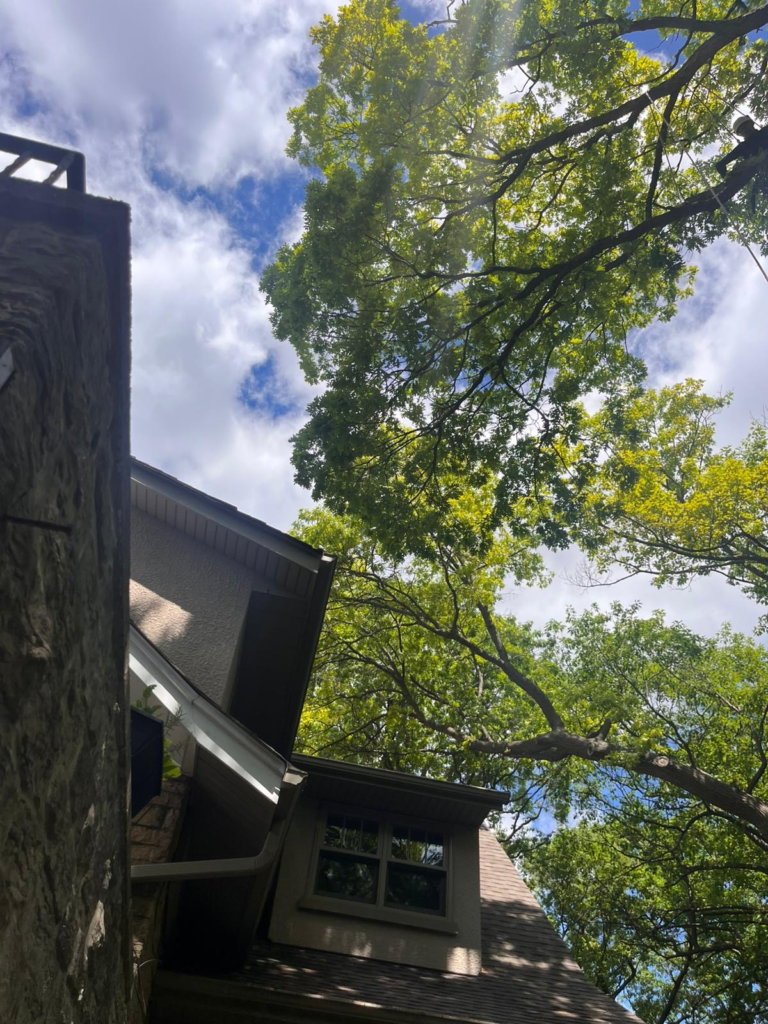
A massive mature tree with a significant lean looming directly over the roofline of a residential home in the Upper Beaches, Toronto. When a heavy, sprawling canopy leans this severely over a structure, the risk of a catastrophic roof strike during high winds or severe storms increases exponentially.
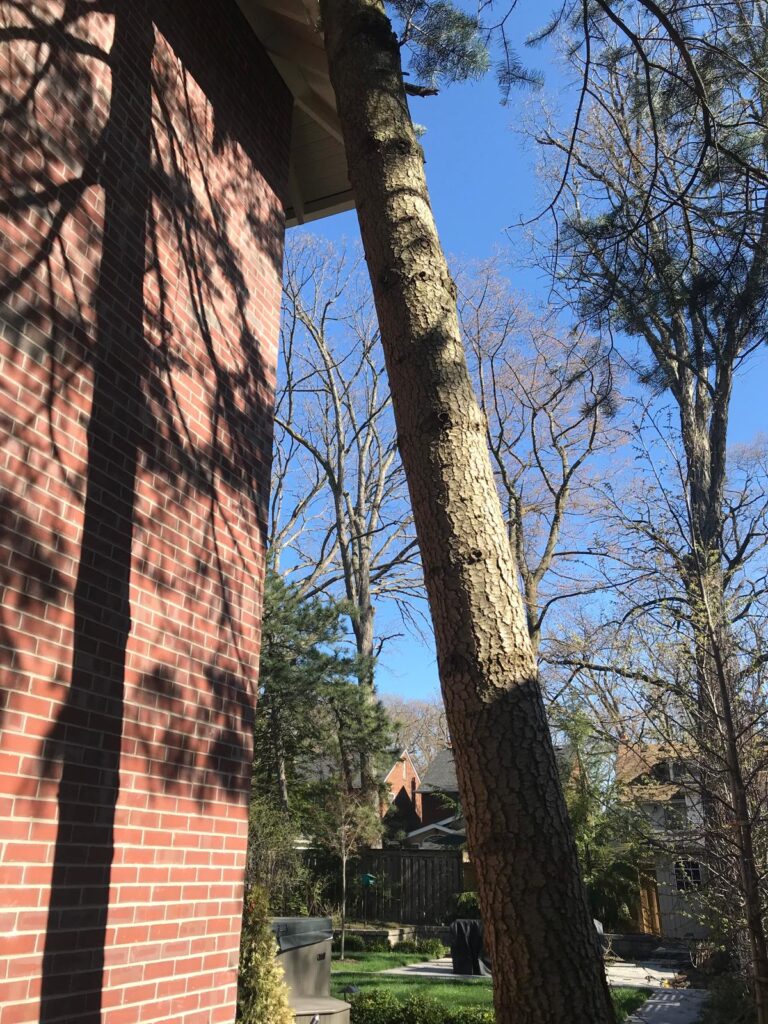
A mature coniferous tree in Forest Hill, Toronto, with a severe lean that has resulted in direct physical contact with the brick exterior and eaves of a residential home.
What an arborist actually checks
A proper assessment looks at:
root plate stability
trunk integrity
canopy balance
species-specific failure patterns
soil conditions or fruiting bodies like mushrooms growing out of roots
soil heaving or compression around the root plate
proximity to structures
It’s less about how the tree looks and more about how it’s behaving.
Possible outcomes after inspection:
In many cases, nothing urgent is required. You may find that:
the tree is stable and simply growing naturally
pruning can reduce weight and wind load
cabling or bracing can stabilize the structure
removal is recommended if failure risk is high
Most leaning trees can be managed. A smaller number need intervention before weather forces the decision.
Why timing matters in the GTA
Toronto’s clay soils and Mississauga’s sandy loam behave differently — but both can destabilize root systems under freeze-thaw cycles, heavy rain, and wind exposure.
A lean that looks minor today can become a liability after one severe weather event.
If you’re unsure whether the lean is structural or natural, an early assessment is far easier — and far less expensive — than emergency removal after a storm.
Bottle Line
A leaning tree isn’t automatically dangerous. But it is a structural question — not a cosmetic one. Knowing the difference early is the easiest way to avoid emergency removals, property damage, or rushed decisions.
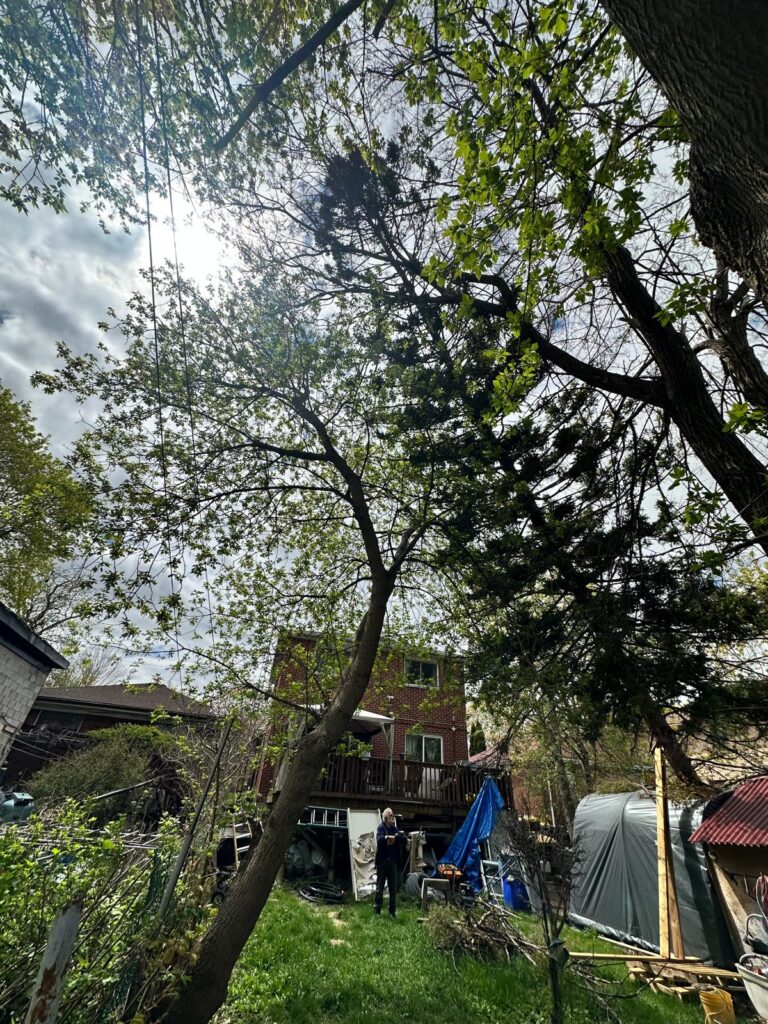
A severe hazard in a dense Riverdale backyard, where a mature tree has developed a drastic, heavy lean directly toward a brick home's rear deck.
Tree Problems We Solve
Precision arboriculture for high-risk and emergency structural threats.
Every catastrophic tree failure presents a unique set of structural tensions and property risks. Explore the specific hazard scenarios below to see exactly how we map, secure, and safely extract heavy timber without causing secondary damages to your property.